Commands
👤 User Commands
These commands can be used by any user.
| Command | Description |
|---|---|
/verify |
Start the email verification process to get access to the server |
/data delete-user |
Delete your personal verification data and remove your verified status |
🔧 Administrator Commands
The following commands require administrator permissions.
👥 Role Configuration
Configure which roles are assigned during the verification process.
Default Roles
Default roles are given to all verified users, regardless of their email domain.
| Command | Description |
|---|---|
/role add <role> |
Add a role to the default roles list |
/role remove <role> |
Remove a role from the default roles list |
/role list |
View all configured default roles |
/role unverified [role] |
Set or view the optional role for unverified members (select current role to disable) |
Domain-Specific Roles
Assign different roles based on which email domain the user verifies with. Users receive their domain-specific roles plus any default roles.
| Command | Description |
|---|---|
/domainrole add <domain> <role> |
Add a role for a specific email domain |
/domainrole remove <domain> <role> |
Remove a role from a specific domain |
/domainrole list |
View all domain-role mappings |
/domainrole clear <domain> |
Remove all roles for a specific domain |
Domain Role Examples
| Setup | Result |
|---|---|
Default: @MemberDomain: @*.edu → @Student |
User with @stanford.edu gets: @Student, @Member |
Default: @VerifiedDomain: @company.com → @Employee, @Staff |
User with @company.com gets: @Employee, @Staff, @Verified |
Domain: @*.harvard.edu → @HarvardDomain: @*.edu → @Student |
User with @cs.harvard.edu gets: @Harvard, @Student (all matching patterns) |
💡 Tip: When using
/domainrole add, the domain field autocompletes with your configured domains from/domain add.
📧 Domain Management
Control which email domains are allowed for verification.
| Command | Description |
|---|---|
/domain add <domains> |
Add allowed email domains (comma-separated for multiple) |
/domain remove <domains> |
Remove allowed domains |
/domain list |
View all currently allowed domains |
/domain clear |
Remove all allowed domains |
Wildcard Support
Use * as a wildcard to match any text:
| Pattern | Matches | Example |
|---|---|---|
@gmail.com |
Only Gmail | user@gmail.com ✓ |
@*.edu |
Any .edu domain | user@stanford.edu ✓, user@mit.edu ✓ |
@*.harvard.edu |
Harvard subdomains | user@cs.harvard.edu ✓, user@law.harvard.edu ✓ |
@company.com |
Specific company | user@company.com ✓ |
🚫 Blacklist Management
Block specific email addresses or patterns from verifying. Supports * wildcard.
| Command | Description |
|---|---|
/blacklist add <patterns> |
Add patterns to the blacklist (supports * wildcard) |
/blacklist remove <patterns> |
Remove patterns from the blacklist |
/blacklist list |
View all blacklisted entries |
/blacklist clear |
Remove all entries from the blacklist |
Blacklist Wildcard Examples
| Pattern | Blocks | Example Matches |
|---|---|---|
spam@example.com |
Specific email | spam@example.com |
*@tempmail.* |
All tempmail domains | user@tempmail.com, test@tempmail.net |
*spam* |
Emails containing "spam" | spam@gmail.com, myspammail@test.com |
test*@* |
Emails starting with "test" | test123@gmail.com, testuser@company.com |
⚙️ Settings
Configure bot behavior and preferences.
| Command | Description |
|---|---|
/settings language <language> |
Change the bot's display language |
/settings log-channel [channel] |
Set a channel for verification logs (leave empty to disable) |
/settings verify-message [message] |
Set a custom message for verification emails (leave empty for default) |
/settings auto-verify <enable> |
Automatically prompt new members to verify when they join |
/settings auto-unverified <enable> |
Automatically assign the unverified role to new members |
🛡️ Moderation & Setup
| Command | Description |
|---|---|
/button <channel> <buttontext> [title] [message] [color] |
Create a verification button embed in a channel |
/manualverify <user> <email> |
Manually verify a user without email confirmation |
/set_error_notify owner |
Send error notifications to the server owner (default) |
/set_error_notify channel <channel> |
Send error notifications to a specific channel |
/set_error_notify user <user> |
Send error notifications to a specific user via DM |
/set_error_notify status |
View current error notification settings |
📊 Information
| Command | Description |
|---|---|
/status |
View bot configuration, verification statistics, and check for setup issues |
/help |
Show setup instructions and command overview |
⚠️ Data Management (Danger Zone)
| Command | Description |
|---|---|
/data delete-server |
Delete all server data and remove the bot from the server |
⚠️ Important Notes
Role Hierarchy
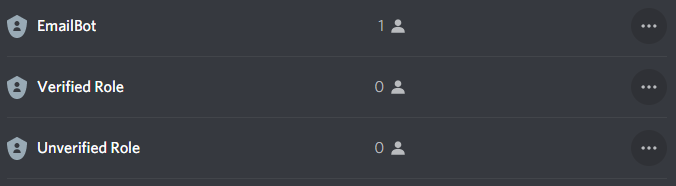
The EmailBot role must be higher in the role hierarchy than both the verified and unverified roles. Otherwise, you'll see this error:
Can't find roles. Please contact the admin!
Unverified Role Usage
The unverified role can be used to:
- Make a verification channel visible only to unverified users
- Restrict access to most channels until users verify
- Combined with /settings auto-unverified, automatically restrict new members
Role Display in Verification
When domain-specific roles are configured, the verification modal shows users which roles they will receive:
Accepted domains:
1. @*.edu → Student, Member
2. @company.com → Employee, Member
This helps users understand what access they'll get before verifying.